

A portable power station for home backup can keep essential devices running during a power outage without using gasoline or producing exhaust. These rechargeable battery systems normally include an internal battery, an inverter, AC outlets and USB ports.
However, choosing the correct size involves more than selecting the largest battery available. You need to calculate how much electricity your essential appliances use, how long you want to run them and how much power they may require when starting.
The U.S. Department of Energy recommends beginning with a load analysis by recording each device’s wattage and expected operating time.
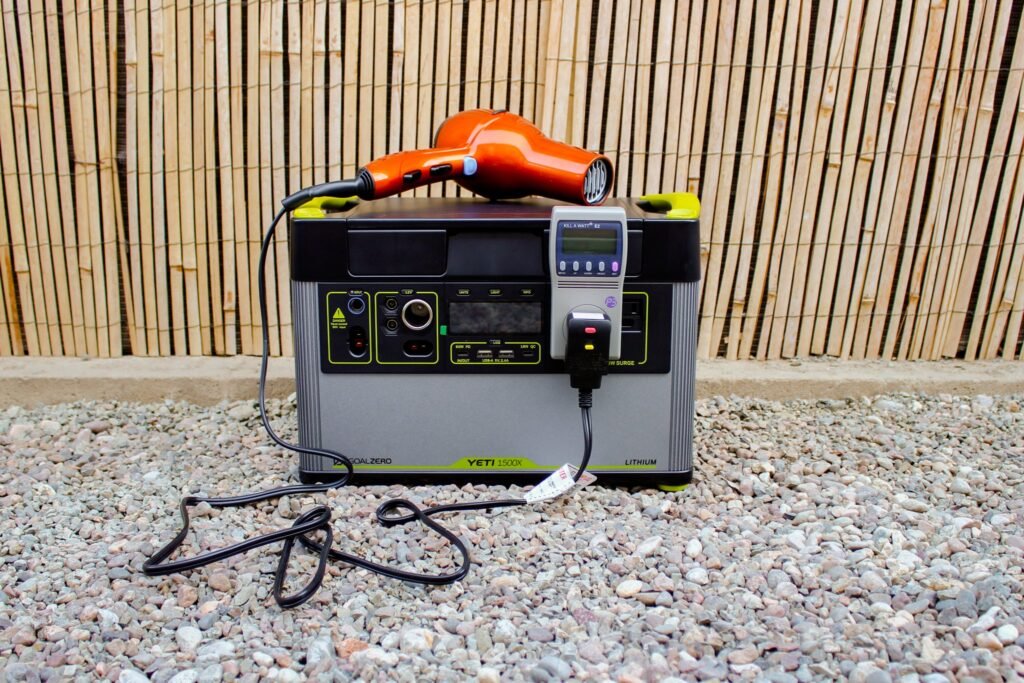
Understand Watts and Watt-Hours
Two specifications are especially important when comparing a portable power station:
Watts (W) measure how much power the unit can deliver at one time.
Watt-hours (Wh) measure how much energy the battery can store.
For example, a power station with a 2,000-watt output may be able to run several appliances together, but its watt-hour capacity determines how long those appliances can continue operating.
A high output rating does not necessarily mean long runtime. Similarly, a large battery may still be unable to operate an appliance if its inverter output is too low.
Step 1: List the Appliances You Need During an Outage
Do not begin by trying to power every appliance in your home. Start by identifying essential loads for power outage preparedness.
These might include:
- Refrigerator
- Internet router
- Mobile phones
- Laptops
- LED lights
- Television
- Medical equipment
- Fans
- Small kitchen appliances
Heating systems, central air conditioners, electric water heaters, clothes dryers and electric ovens can require significantly more power. A normal portable unit may not be suitable for these loads.
Ready.gov advises households to make an inventory of items that depend on electricity and prepare alternative power sources for essential needs. People using refrigerated medicine or power-dependent medical equipment should also maintain a separate emergency plan rather than relying on one backup device.
Step 2: Find Each Appliance’s Wattage
Check the appliance label, power adapter, manual or manufacturer’s specifications.
When wattage is not listed, it may sometimes be calculated using:
Watts = Volts × Amps
For example, an appliance labelled 120 volts and 1 amp would use approximately 120 watts under the stated operating condition.
Actual consumption may change while the appliance is operating. Refrigerators and some other devices switch on and off instead of drawing their full rated power continuously.
The Department of Energy recommends using the wattage shown on the appliance and multiplying it by the number of hours the appliance is expected to operate.
Step 3: Calculate the Energy Required
Use this formula for each appliance:
Energy required in watt-hours = appliance wattage × hours of use
Here is a hypothetical example:
| Appliance | Wattage used for calculation | Operating time | Energy needed |
|---|---|---|---|
| Refrigerator | 150 W | 8 equivalent hours | 1,200 Wh |
| Internet router | 15 W | 12 hours | 180 Wh |
| LED lights | 40 W | 5 hours | 200 Wh |
| Laptop | 65 W | 4 hours | 260 Wh |
| Phone charging | 20 W | 3 hours | 60 Wh |
| Estimated total | 1,900 Wh |
These figures are examples only. Your refrigerator, router and other appliances may use different amounts of electricity.
A household requiring approximately 1,900 Wh should not select a battery rated at exactly 1,900 Wh. Some stored energy is lost during conversion, and the full advertised capacity may not always be available through the AC outlets.
For planning purposes, add a reasonable reserve rather than operating the unit at its absolute limit. In this example, the homeowner might begin comparing units above the calculated requirement and then check the manufacturer’s stated usable capacity.
Step 4: Check Continuous and Surge Output
Battery capacity determines runtime, but inverter output determines which appliances can operate.
Look for two output specifications:
Continuous output is the amount of power the station can supply during normal operation.
Surge output is the higher amount it can provide briefly when an appliance starts.
Refrigerators, pumps, power tools and devices containing motors or compressors can require additional startup power. The Department of Energy advises considering the starting surge of equipment when selecting an inverter.
Add the wattage of every appliance that may operate at the same time. The combined total should remain below the power station’s continuous output.
You should also confirm that the unit’s surge rating can support the highest startup requirement. Do not assume that a temporary “boost” mode will make every appliance compatible.
Step 5: Estimate Runtime
A basic runtime estimate is:
Estimated runtime = usable battery capacity ÷ appliance wattage
For example, if a power station provides 1,500 Wh of usable energy and the connected load averages 300 watts:
1,500 Wh ÷ 300 W = approximately 5 hours
Real-world runtime may be shorter because of inverter losses, changing appliance demand, temperature and the power consumed by the unit itself.
For appliances that cycle on and off, such as refrigerators, a plug-in electricity monitor can provide a more useful estimate than relying only on the maximum wattage label.
Step 6: Decide Whether You Need Expandable Capacity
Some portable power stations support additional battery modules.
Expandable capacity may be useful when you want:
- Longer emergency backup power
- Support for several essential appliances
- Additional runtime during multi-day outages
- The ability to increase capacity later
- A larger battery backup for power outages
Before choosing an expandable system, check the maximum supported battery capacity, connector requirements and whether all batteries must use the same model.
A portable system should not automatically be treated as a whole-home backup power solution. Running circuits through a home electrical panel may require specially certified equipment, an approved transfer device, permits and professional installation.
UL Solutions explains that portable power packs and permanently installed residential battery systems fall under different safety standards. Portable packs may be evaluated under UL 2743, while stationary residential energy-storage systems generally require certification under UL 9540.
Step 7: Consider Solar Recharging
A power station that accepts solar input is sometimes marketed as a solar generator for home backup.
The battery does not generate solar energy by itself. It must be connected to compatible solar panels, and recharging performance depends on:
- Panel wattage
- Available sunlight
- Weather conditions
- Panel angle and position
- Solar-input limits
- Cable compatibility
- Energy being used while charging
Check the station’s maximum solar-input voltage, current and wattage before connecting panels. A larger solar array will not necessarily charge the battery faster if the unit’s input controller cannot accept the additional power.
Solar charging may extend backup time, but homeowners should not assume that a small panel will fully recharge a large battery every day.
Step 8: Compare Battery and Safety Features
Many shoppers now search for a LiFePO4 portable power station because battery chemistry has become an important buying consideration. Instead of relying only on marketing terminology, review the unit’s documented cycle rating, operating-temperature limits, battery-management system, warranty and safety certification.
The Department of Energy notes that lithium iron phosphate chemistry has characteristics associated with improved thermal stability compared with several other lithium-ion cathode types. However, every battery system still needs proper design, charging controls and safe use.
Before purchasing:
- Check for recognized independent safety certification.
- Search the model on the CPSC recalls website.
- Use only compatible charging cables and adapters.
- Do not use a damaged, swollen or recalled unit.
- Keep the system dry and follow its ventilation requirements.
- Do not block cooling vents.
- Follow the manufacturer’s storage and charging instructions.
Recent CPSC recalls and warnings show that defective portable power stations can overheat or catch fire, making model-specific safety checks important.
Portable Power Station Sizing Checklist
Before choosing a unit, confirm:
- Which appliances are genuinely essential
- The running wattage of each appliance
- Expected daily operating hours
- Total watt-hours required
- Combined simultaneous wattage
- Motor or compressor startup demand
- Required outage duration
- Whether solar charging is needed
- Whether expandable batteries are supported
- Safety certification and recall status
- Indoor storage and operating requirements
- Whether professional electrical installation is necessary
Conclusion
The right portable power station for home backup is determined by your appliances and expected runtime—not simply by the advertised battery size.
Calculate watt-hours for essential devices, check continuous and surge output, add a sensible reserve and verify that the selected equipment can safely operate each load. For many households, prioritizing a refrigerator, communications, lighting and device charging will be more practical than attempting to power the entire home.
A properly sized system can support basic comfort and communication during a temporary outage. However, medical devices, extreme temperatures and extended emergencies should always be covered by a broader emergency plan.
This article provides general educational information. Electrical requirements, building codes and equipment capabilities vary. Follow the manufacturer’s instructions and consult a qualified electrician before connecting backup equipment to household wiring.